
What VO2 Max Tells Me About Your Health
by Dr. Chuck Svendsen
As a bariatric surgeon for 25 years, I learned an undeniable pattern that I saw across thousands of patients. That is part of the job: pattern recognition. Before I ever made an incision, I could often tell how a patient was going to do afterward.
Some patients came into the operating room with margin to spare. An anesthetic hit, a rough night, a small complication, and they absorbed it without much trouble. That is what people mean when they say there is no substitute for being young. Except it was never really about being young; it was about having a reserve.
Other patients arrived already operating at their ceiling just to walk in from the parking lot. A high resting heart rate or getting winded from walking down the hallway were always worrisome signs for me. Same age, same operation, same surgeon. Very different recoveries.
I had no way to measure it back then. Now I do.
Altitude
Think of your aerobic fitness as altitude.
Every day, you fly at some height above the ground. The ground is what your daily life actually demands. Getting out of a chair. Carrying groceries. Climbing the stairs to your own bedroom. Walking an airport concourse with a bag on your shoulder.
Fly high, and daily demands of life are uncomfortable but survivable. You have room. You have options. Fly low enough, and every bump matters.
VO₂ max is the measurement of your altitude. It is the maximum amount of oxygen your body can take in and use, and it is the best objective measure of cardiorespiratory fitness we have. It's basically done as a cardiorespiratory stress test in a lab. We measure VO₂ max in milliliters of oxygen per kilogram of body weight per minute.
Here is what the ground looks like in those units:
VO₂ Max about 14 = Walking briskly
At about 21 = Carrying groceries up a flight of stairs
And up to about 28 = Hiking, dancing, doubles tennis
So if your VO₂ max is 22 and carrying groceries upstairs costs 21, you can still do it. But you will be close to your max effort. You will stop on the landing. Eventually you will start arranging your life so you do not have to do it again.
That rarely feels like a fitness problem. It feels like a preference. “I just don’t feel like going anymore.”
That is altitude loss, and it is quiet.
So how high are you flying?
Here is where most people get stuck. You know your blood pressure. You probably know your cholesterol. Almost nobody knows their VO₂ max, and the few who do have no idea whether their number is any good.
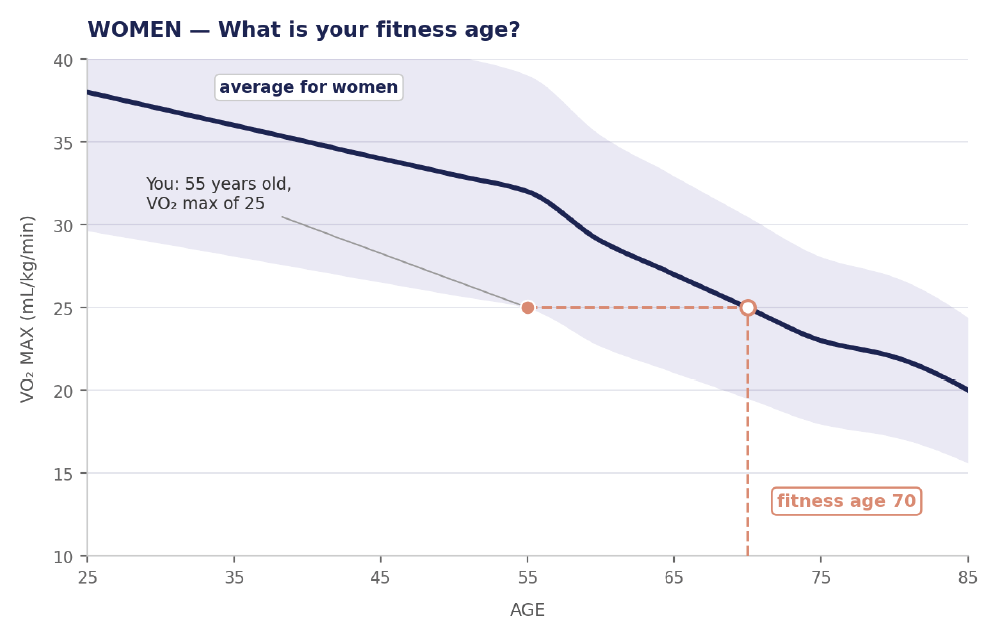
Let’s fix that. Find your VO₂ max up the side on the relevant chart below. Now slide sideways until you reach the line. The age you land on is your fitness age — the age at which your number would be perfectly average.
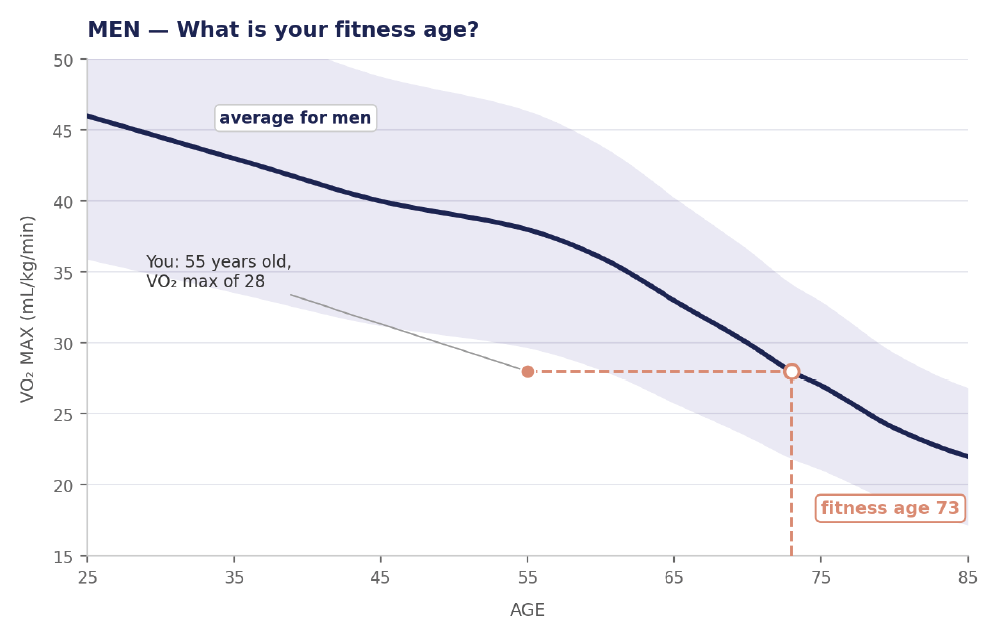
The man in the first chart is 55 years old with a VO₂ max of 28. An average VO₂ max for a 55-year-old man is about 38. His 28 is average for a 73-year-old.
His fitness age is 73. He is 55.
That's an eighteen year gap. And here is the thing. He does not feel eighteen years older. He feels fine. He feels fine right up until he is carrying something heavy up a flight of stairs, and then he feels 73.
I can hear your reply already. “But I already exercise!”
Maybe. Most people who tell me that are walking. I want you to keep walking — walking is wonderful for a dozen reasons. But after the first few months, walking maintains your VO₂ max. It does not build it. Those are two different jobs, and most people are only doing one of them.
Yes, some decline is coming for all of us. Aerobic capacity falls with age in every single person, and the fall accelerates after seventy. I am not going to pretend otherwise.
The part that should make you optimistic
Here is the good news, and it is genuinely good. Fitness age moves. It moves fast.
The HERITAGE Family Study put more than 700 previously sedentary adults, across the full adult age range, through 20 weeks of supervised training. Average VO₂ max improvement was about 17%. And keep in mind that this was for adults of all ages, not just twenty-somethings.
So let's run that through the chart again. With a 17% improvement, our 55-year-old man goes from 28 to 33. His fitness age falls from 73 to 65! The woman in the second chart goes from 25 to 29, and her fitness age falls from 70 to 60. In five months!
Your birthday is not negotiable. Your fitness age is.
You will feel this payoff when you’re walking up the stairs, but it has hidden benefits too. In the largest cardiorespiratory fitness study ever conducted, with 750,302 U.S. veterans, each 1 MET improvement in fitness was associated with roughly 13% lower risk of dying from any cause.³ (MET is short for metabolic equivalent of task; it’s a concept similar to VO₂ max, with 1 MET equivalent to 3.5 units of VO₂ max.) That held across age, sex, BMI, and existing medical conditions. No group was too old to benefit.
Why the bathroom scale is the wrong instrument
You already know my position. I care about where your fat sits and how much muscle you are carrying, not what a bathroom scale tells you at 6 a.m. VO₂ max is that same argument arriving from a different direction.
The two travel together. Aerobic capacity is measured per kilogram of you, so body composition moves the number directly. That is exactly why every willing Astride member gets a DEXA scan, and why we measure VO₂ max directly instead of estimating it off a formula or a wearable.
You cannot manage what you have not measured. You certainly cannot build a precision health plan on a guess.
So where do you start?
If you’re an Astride member, you know that we do your first VO₂ max test in your first month of working with us. Then you get a plan that is tailored to you.
And that’s why we call it “training for life”. Not training for a race. Training so that at 82 you carry your own groceries up your own stairs, and it costs you nothing to do it. That takes a plan, and it takes a partner who will hold you to it. This is the parter that we aim to be at Astride Health. We measure your fitness regularly using this approach:
● In-person VO₂ max testing — measured, not estimated off a formula.
● A DEXA scan, so we know your body composition, and where you’re carrying your weight.
● An exercise prescription built by our exercise physiologist around your real results: easy aerobic work to build the base, higher-intensity intervals dosed for you to move the ceiling, and resistance training to protect the muscle that carries the whole number.
● We retest DEXA scan every 6 months, and your VO₂ max every 12 months to check progress and make adjustments.
This approach helps us build a Precision Health Plan that uniquely works for you today and for decades to come.
References
Fleg JL, Morrell CH, Bos AG, Brant LJ, Talbot LA, Wright JG, Lakatta EG. Accelerated longitudinal decline of aerobic capacity in healthy older adults. Circulation. 2005;112(5):674-682.
Bouchard C, An P, Rice T, Skinner JS, Wilmore JH, Gagnon J, Pérusse L, Leon AS, Rao DC. Familial aggregation of VO₂max response to exercise training: results from the HERITAGE Family Study. J Appl Physiol. 1999;87(3):1003-1008.
Kokkinos P, Faselis C, Samuel IBH, Pittaras A, Doumas M, Murphy R, Heimall MS, Sui X, Zhang J, Myers J. Cardiorespiratory fitness and mortality risk across the spectra of age, race, and sex. J Am Coll Cardiol. 2022;80(6):598-609.
Kaminsky LA, Arena R, Myers J. Reference standards for cardiorespiratory fitness measured with cardiopulmonary exercise testing: data from the Fitness Registry and the Importance of Exercise National Database (FRIEND). Mayo Clin Proc. 2015;90(11):1515-1523.